A practical guide to crypto wallet ownership verification: private keys, addresses, message signing, wallet signatures, proof of funds, KYC, security, and institutional workflows.
Proving ownership of a crypto wallet is becoming a normal part of financial life. A lender may need to verify crypto collateral before approving a loan. A mortgage broker may need evidence that a deposit came from a wallet controlled by the applicant. An accountant may need to connect a taxpayer to a set of self-custodied addresses. A wealth manager may need to assess a client's digital assets without asking for private keys. An auditor may need a defensible record that an organisation controlled certain wallets at a particular point in time.
The common question sounds simple: how do you prove you own a crypto wallet?
The answer is more precise than most people expect. You do not prove wallet ownership by sending a screenshot, exporting a seed phrase, or showing a block explorer page. You prove control by using the wallet's private key to produce a cryptographic signature for a specific message. A verifier can then check that signature against the public wallet address.
Throughout this guide, "wallet ownership verification" and "wallet control verification" are used interchangeably. In practice, institutions are usually verifying control of the relevant private key or signing authority, not making a final legal determination about ownership.
That process is also called message-signature verification. It is the foundation for many related workflows, including crypto-backed lending, proof of wealth, proof of funds, tax reviews, family office reporting, institutional onboarding, source-of-funds checks, and financial audits.
This guide explains the underlying concepts, the verification flow, the differences between major wallets and chains, the security risks, and the standards institutions should expect in 2026.
Quick Answer
To prove you own a crypto wallet:
- Receive a unique challenge message.
- Sign it using the wallet's private key or authorised signing mechanism.
- Return the signature to the verifier.
- The verifier checks the signature cryptographically against the public wallet address.
No funds move. No private keys are shared. No seed phrase is revealed.
At a Glance
| Evidence | Proves ownership? | Proves funds? |
|---|---|---|
| Screenshot | No | Weakly, if genuine and current |
| Block explorer | No | Yes, for visible on-chain assets |
| Exchange statement | No, not for a self-custodied wallet | Yes, for assets held with that exchange |
| Wallet signature | Yes | No |
| Wallet signature plus balance check | Yes | Yes, within the scope and time of the check |
Contents
- What does it actually mean to own a crypto wallet?
- Why screenshots don't prove ownership
- How wallet ownership is proven cryptographically
- What happens during wallet verification?
- How to prove ownership using different wallets
- Bitcoin vs Ethereum wallet verification
- Wallet ownership vs proof of funds
- Wallet ownership vs identity verification
- Common mistakes
- Security considerations
- Institutional use cases
- Frequently Asked Questions
What does it actually mean to own a crypto wallet?
In everyday language, people say they "own a wallet" or "own an address". Technically, a wallet is software or hardware that manages cryptographic keys. The assets are not inside the wallet. They are recorded on a blockchain. The wallet controls the keys needed to authorise actions from one or more addresses. That is the core idea behind self-custody wallet verification.
Four terms matter:
- Private key: the secret value that can authorise signatures and transactions.
- Public key: a value derived from the private key that can be shared.
- Address: a shorter public identifier derived from the public key or script.
- Wallet: the application, device, or key-management system that stores or accesses private keys.
The relationship is one-way:
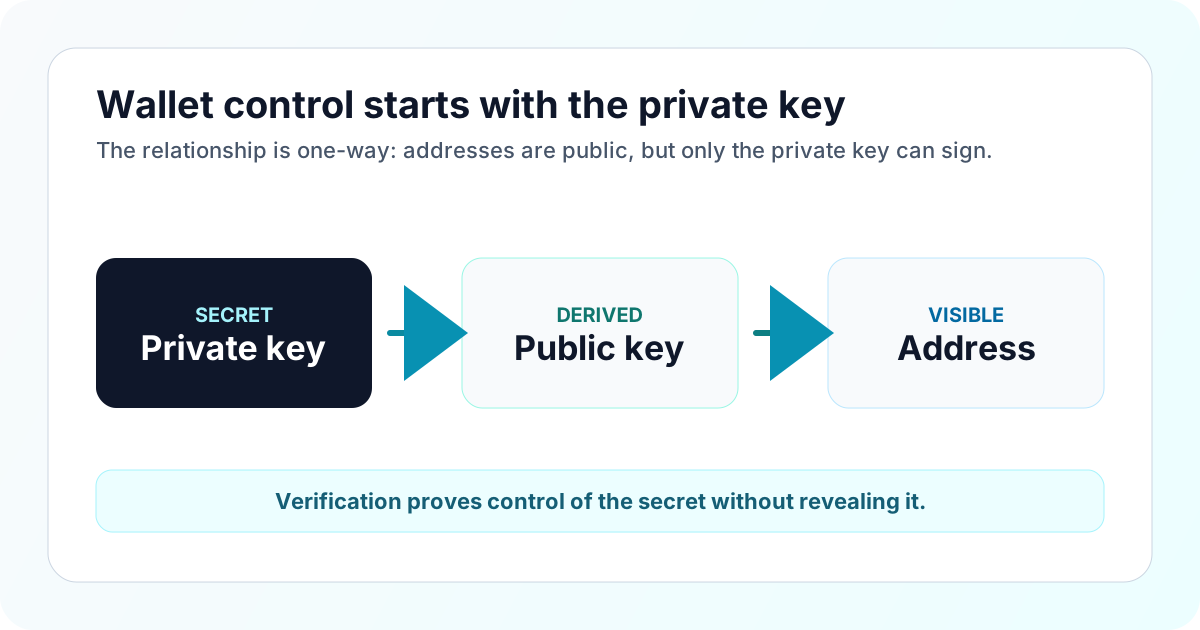
Anyone can see many public addresses. On public blockchains, anyone can look up a Bitcoin address or Ethereum address and inspect visible balances and transactions. That visibility does not prove who controls the address.
The controller is the person or system that can use the relevant private key to produce a valid signature. In self-custody, that private key is normally held by the user through a seed phrase, hardware wallet, mobile wallet, browser wallet, desktop wallet, or institutional custody setup.
Important: In technical verification, "ownership" usually means control of the private key or signing authority. Legal ownership may require additional evidence, such as contracts, corporate authorisations, trust documents, account records, or identity checks.
Consider a simple example. Alice says she owns a Bitcoin address. Bob can paste the address into a block explorer and see that it holds 2 BTC. That proves the address exists and has a visible balance. It does not prove Alice controls it. Alice could have copied the address from someone else. The stronger proof is for Bob to send Alice a unique message and ask her to sign it with the wallet controlling that address. If the signature verifies, Bob knows the address was controlled by whoever signed the message.
Why screenshots don't prove ownership
Screenshots are common because they are easy. They are also weak evidence.
A wallet screenshot may show an address, balance, or transaction list. A block explorer screenshot may show on-chain balances. An exchange statement may show that a customer had assets at a custodial platform. None of those prove self-custody wallet control.
Screenshots fail for several reasons:
- they can be edited with ordinary image tools
- they can be taken from another person's wallet or explorer view
- they may omit the full address
- they may be out of date as soon as assets move
- they rarely show the exact review context
- they do not create a cryptographic link between the claimant and the address
Even when a screenshot is genuine, it is only visual evidence. It asks the reviewer to trust an image. A cryptographic signature asks the reviewer to verify a mathematical relationship.
Exchange statements have a different limitation. They may prove that a person had an account with a custodian. They do not prove that the person controls a self-custodied wallet. A withdrawal record may help show a path of funds, but it is still not the same thing as signing from the destination wallet.
For low-risk personal admin, a screenshot may be enough. For lending, mortgage underwriting, audits, wealth reporting, litigation, corporate treasury, or compliance onboarding, it is usually not.
How wallet ownership is proven cryptographically
Wallet ownership is usually proven with message signing.
Message signing allows a wallet to sign a piece of text without sending a transaction and without moving funds. The message might say:
I confirm that I control address 0x1234...abcd for Example Lender verification request 8F4C2 on 7 July 2026. This signature does not authorise any transaction.
The wallet uses the private key to create a digital signature for that exact message. The verifier receives three things:
- the message
- the public address
- the signature
The verifier checks whether the signature is valid for that message and address. If it is valid, the verifier knows that the message was signed by a private key corresponding to that address.
No private key is shared. No seed phrase is disclosed. No transaction is broadcast. The signature is evidence of control for a specific message.
This is often described as a challenge-response process:
- The verifier creates a challenge.
- The wallet signs the challenge.
- The verifier checks the response.
The challenge should be unique, scoped, and time-limited. A good challenge includes the requesting organisation, the purpose of the request, the wallet address, a unique request identifier (sometimes called a nonce), a timestamp, and a clear statement that the message is not a transaction authorisation.
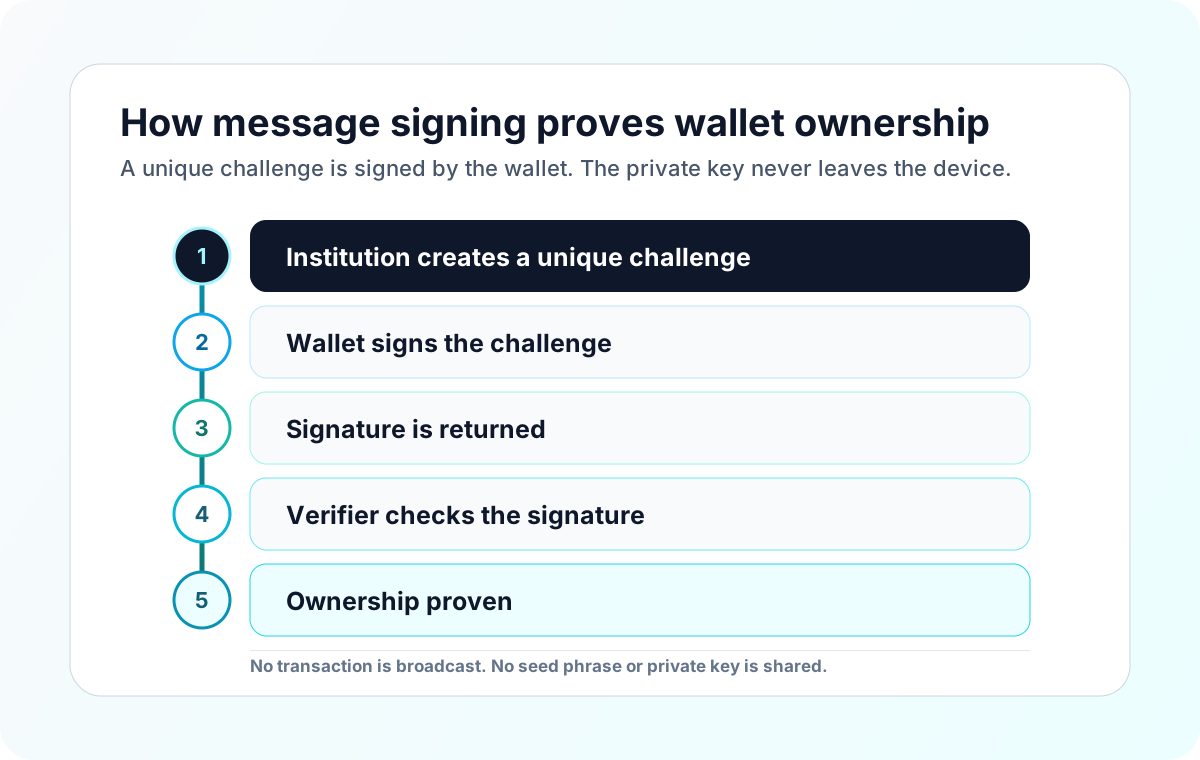
The standalone version of this message-signing diagram is available as an SVG file.
What happens during wallet verification?
The practical flow is straightforward, but each step matters.
Example: Sarah is applying for a mortgage and wants to use self-custodied crypto as part of her evidence of wealth. The lender asks her to prove control of a Ledger wallet. Sarah receives a unique challenge, reviews it, and signs it through her wallet. The lender verifies the returned signature against the wallet address, then checks the wallet balance separately. The signature proves control; the balance check proves the relevant assets were present at the time of review.
| Step | What happens | Why it matters |
|---|---|---|
| 1. Institution defines the request | The lender, adviser, accountant, auditor, or compliance team identifies the wallet and the reason for verification. | The user should know what is being verified and why. |
| 2. Verification challenge is generated | A unique message is created for the specific request. | A unique challenge reduces replay risk and ties the proof to one workflow. |
| 3. User reviews the message | The user checks the message in their wallet or hardware device. | The user should understand what they are signing before approving it. |
| 4. Wallet signs the message | The wallet produces a digital signature using the private key. | The private key stays inside the wallet or device. |
| 5. Signature is returned | The signature, message, and address are sent to the verifier. | The verifier has enough information to check the proof independently. |
| 6. Cryptographic verification is performed | The verifier checks that the signature matches the message and address. | This is the actual proof of wallet control. |
| 7. Evidence is recorded | The result is stored with timestamp, scope, and request metadata. | A later reviewer can understand what was proven. |
The flow can be reduced to this:
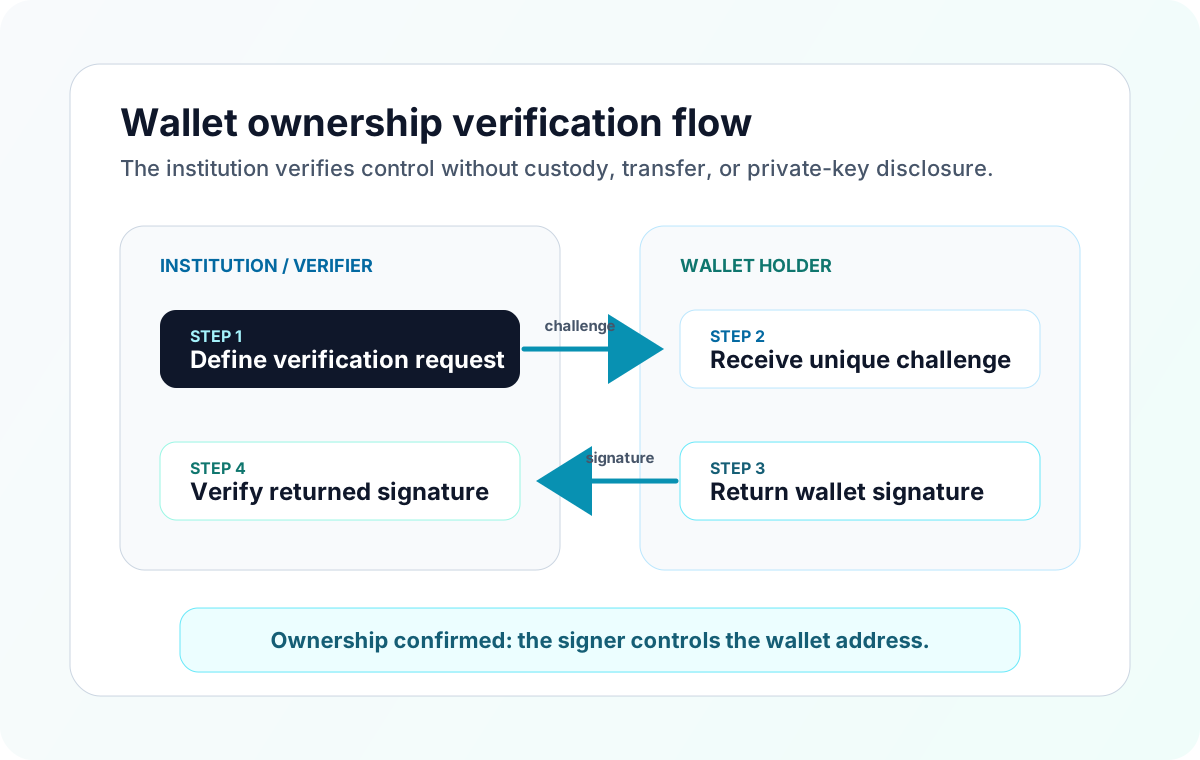
The private key remains inside the wallet or signing device throughout the process.
How to prove ownership using different wallets
The concept is consistent across wallets, but the user experience varies. Some wallets expose message signing directly. Others rely on connected applications, developer APIs, command-line tools, or hardware-wallet integrations.
Ledger
Ledger devices are hardware wallets. Their purpose is to keep private keys isolated from the computer or phone requesting a signature. In a verification workflow, the Ledger device signs after the user confirms the request on the device.
For Ethereum and other EVM accounts, Ledger is often used through a wallet interface such as MetaMask. MetaMask notes that Ledger and Trezor hardware wallets support personal_sign for signing data through MetaMask, while not every typed-data method is supported for hardware-wallet accounts. This matters because a verification flow must request a signing method the device can actually complete.
For Bitcoin, Ledger users may rely on compatible desktop wallets or wallet tooling that can request a Bitcoin message signature from the device. The exact path depends on the account type, wallet software, and supported address format.
Practical guidance:
- use a challenge message that is readable on the device or companion wallet
- confirm the address shown in the verification request matches the account being used
- avoid workflows that require exporting private keys or seed phrases
- test the signing method before deploying it to customers at scale
Trezor
Trezor devices also keep private keys on the hardware wallet. Trezor Suite supports signing and verifying Bitcoin messages for proving ownership of a specific address. The user selects the account, enters the message and address, confirms the message on the Trezor device, and receives a signature.
For EVM accounts, Trezor is commonly used through MetaMask or other compatible wallet interfaces. As with Ledger, hardware-wallet support can depend on the requested signing method. A plain personal_sign flow is more broadly compatible than some structured signing methods.
Practical guidance:
- for Bitcoin, use Trezor Suite or a compatible wallet that supports sign and verify
- for EVM, ensure the verifier supports the method available to the hardware wallet
- ask the user to confirm the message text on the trusted display where possible
- document the address format and chain being verified
MetaMask
MetaMask is one of the most common browser and mobile wallets for Ethereum and EVM-compatible networks. For wallet ownership verification, the most relevant methods are:
personal_signfor signing a human-readable messageeth_signTypedData_v4for signing structured EIP-712 data
For basic ownership verification, personal_sign is often sufficient and widely supported. It signs a message using the Ethereum signed-message format described by EIP-191. The verifier can recover the signing address from the signature and compare it with the address claimed by the user.
Structured signing can be useful when the message has multiple fields, such as organisation name, request ID, expiry, permitted purpose, and domain. It can be more legible and safer when implemented well. However, hardware-wallet support and cross-wallet compatibility should be checked before requiring it.
Practical guidance:
- avoid deprecated or unsafe signing flows
- make the message human-readable
- include the verifier name, purpose, request identifier, expiry, and address
- verify the recovered address exactly
- account for chain context, especially with EVM addresses reused across networks
Bitcoin Core
Bitcoin Core can sign messages where the wallet has the private key for the relevant address. This is usually accessed through RPC or command-line tooling rather than a consumer wallet button.
Bitcoin message signing has a long history, but reviewers should be careful with address types and verification tooling. A verifier must use a method that matches the address and signature format produced. Watch-only wallets cannot sign because they do not hold private keys.
Practical guidance:
- use the exact address being claimed
- keep the challenge message unchanged between signing and verification
- confirm that the verifier supports the relevant Bitcoin address type
- treat command-line signing as suitable for technical users, not ordinary consumer onboarding
Electrum
Electrum is a popular Bitcoin wallet for technical users. It supports signing and verifying messages through its wallet interface. Hardware wallets can also be used with Electrum in some setups, depending on the device and configuration.
Electrum is useful when a user needs Bitcoin-specific message signing without writing RPC commands. As with other Bitcoin tools, compatibility depends on the address type and verification method.
Practical guidance:
- sign from the address under review
- use the built-in sign/verify tools rather than screenshots
- keep a record of message, address, and signature
- remember that watch-only Electrum wallets cannot sign
Bitcoin vs Ethereum wallet verification
Bitcoin and Ethereum both use digital signatures, but their verification conventions are not identical.
| Topic | Bitcoin | Ethereum and EVM |
|---|---|---|
| Common signing purpose | Prove control of a Bitcoin address. | Prove control of an account address or sign structured data. |
| Common signature scheme | ECDSA on secp256k1 for traditional signatures; newer script types may involve additional nuance. | ECDSA on secp256k1 for externally owned accounts. |
| Message format | Bitcoin signed-message formats with Bitcoin-specific prefixes and address handling. | EIP-191 for `personal_sign`; EIP-712 for typed structured data. |
| Verification approach | Check the signature against the message and claimed Bitcoin address using compatible tooling. | Recover the signing address from the signature and compare it with the claimed address. |
| Common user tools | Bitcoin Core, Electrum, Trezor Suite, hardware-wallet integrations. | MetaMask, WalletConnect-compatible wallets, hardware wallets through EVM interfaces. |
The important point is not that one chain is easier or safer. It is that verification must use the correct rules for the chain and wallet. A Bitcoin message verifier cannot assume Ethereum address recovery. An Ethereum personal_sign verifier cannot assume Bitcoin signed-message formatting. A robust platform should treat each chain as its own verification environment.
Wallet ownership vs proof of funds
Wallet ownership and proof of funds are related but different.
Wallet ownership answers: can this person or entity control the wallet address?
Proof of funds answers: does the wallet hold sufficient assets for the stated purpose?
Ownership alone does not prove funds. A user can sign from an empty wallet. Funds alone do not prove ownership. A block explorer can show a large balance, but the person presenting it may not control the address.
In serious workflows, both may be needed:
- Prove the user controls the wallet.
- Check the relevant balances or assets.
- Record the time of the balance check.
- Define whether the evidence must remain current.
- Add transaction history or source-of-funds evidence only when the use case requires it.
A mortgage deposit review may require ownership, balance, source of funds, and a transaction path to fiat. A crypto-backed loan may require ownership, balance, collateral eligibility, and ongoing monitoring. A simple wealth-management onboarding check may only need ownership plus a snapshot of assets above a threshold.
Wallet ownership vs identity verification
KYC and wallet verification solve different problems.
Identity verification asks: who is this person or entity?
Wallet verification asks: does this person or entity control this wallet?
One does not replace the other. A passport check does not prove control of a wallet. A wallet signature does not prove the legal identity of the signer. The value comes from linking them in a controlled workflow.
For an individual, that may mean the same person completes identity verification and signs from the wallet. For a company, it may mean an authorised officer completes verification and signs from treasury wallets under an approved policy. For a trust, fund, or family office, it may involve trustees, advisers, or authorised operators.
Institutions should avoid treating wallet verification as a magic identity layer. It is stronger when scoped correctly: identity evidence establishes who is participating; wallet evidence establishes control of the address; transaction and balance evidence establish financial facts.
The institutional evidence stack usually looks like this:
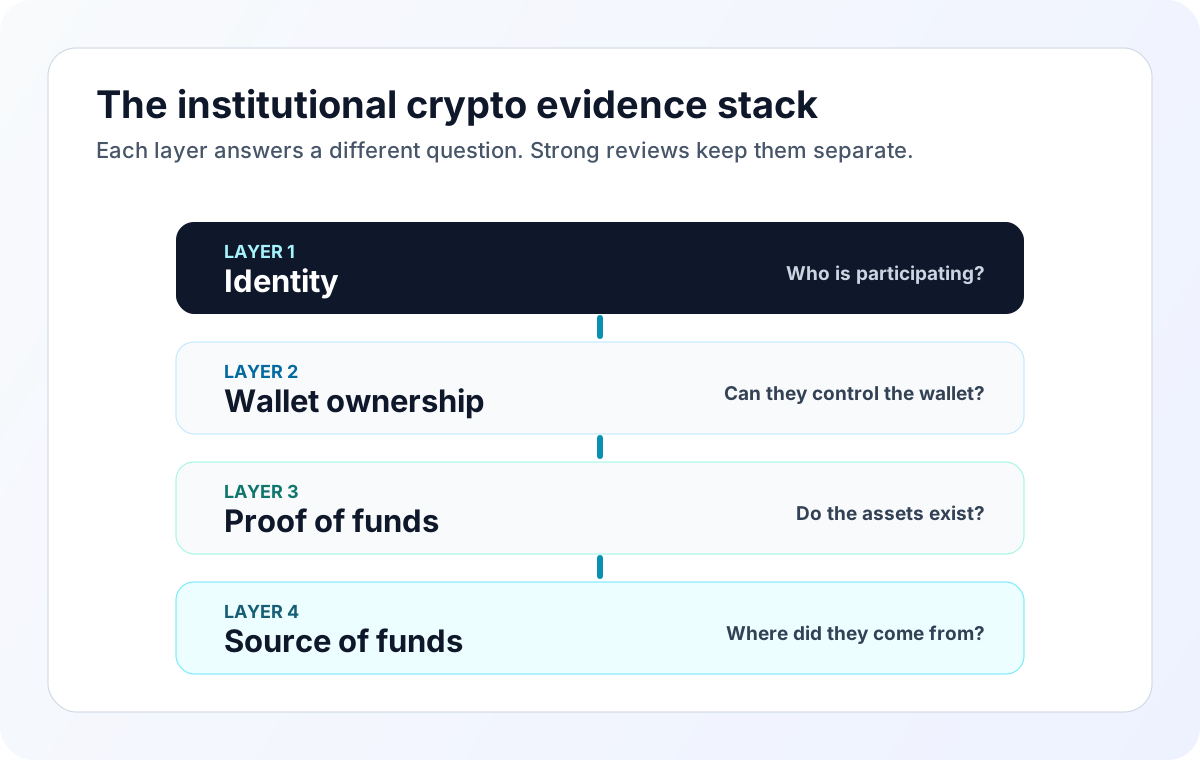
Each layer answers a different question. Strong workflows keep those questions separate, then connect the evidence in a reviewable record.
Common mistakes
Signing with the wrong wallet
Users often hold multiple wallets, accounts, chains, and hardware-device profiles. Signing with the wrong address proves control of the wrong address. The verifier should compare the claimed address with the recovered or verified signing address.
Using stale or expired challenges
A challenge should not be reusable forever. If an old challenge can be signed months later, it may not prove the fact needed for the current review. Include an expiry and request ID.
Allowing replay attacks
If the same signed message can be reused with another institution or another workflow, the challenge is too generic. Include the verifier name, domain, purpose, request identifier, timestamp, and expiry.
Asking users to sign arbitrary messages
Users should not be trained to sign messages they do not understand. A good verification message is explicit. It should say what the signature is for and what it does not authorise.
Confusing transaction approval with message signing
A message signature should not transfer assets or grant token approvals. Users should still check wallet prompts carefully. If the wallet shows a transaction, contract interaction, approval, permit, or spending request, that is not a simple ownership signature.
Ignoring smart-contract wallets
Not every wallet is a simple externally owned account. Smart-contract wallets, multisig wallets, and account-abstraction wallets may need different verification logic. The signer may be an authorised key rather than the final wallet contract itself. Institutions should define what counts as control for these wallet types.
Forgetting corporate authority
For companies and funds, technical control is not the same as authority. An employee may be able to sign from a wallet but not be authorised to represent the organisation. Pair wallet verification with corporate authority checks where needed.
Security considerations
Message signing is normally safe when the message is clear, limited, and not a transaction. The private key does not leave the wallet. The user is not granting custody. The signature proves control without moving assets.
That does not mean every signing request is harmless. Users should review signing prompts carefully, especially in browser wallets where malicious sites may request confusing signatures.
Good security practice includes:
- never share a seed phrase or private key
- sign only messages you understand
- verify the requesting domain or application
- check the address being verified
- prefer hardware-wallet confirmation for high-value wallets
- avoid blind signing unless you understand the risk
- reject messages that appear to authorise transfers, approvals, or broad permissions
- keep signatures tied to a specific purpose and expiry
Hardware wallets improve security because the private key stays on the device and the user can confirm actions on a trusted display. They do not remove the need to understand the request. A user can still sign the wrong message if the workflow is poorly designed.
Institutions also have responsibilities. They should not ask for seed phrases, private keys, full wallet access, unnecessary transaction history, or vague signatures. They should present clear messages, collect the minimum evidence needed, and keep auditable records.
Institutional use cases
Wallet ownership verification is useful anywhere a financial or professional decision depends on self-custodied crypto.
Crypto-backed lending
Before a lender treats crypto as collateral, it needs to know that the applicant controls the wallet and that eligible assets are present. A signature proves control. Balance and monitoring evidence address collateral sufficiency.
Mortgage underwriting
When a deposit comes from crypto, brokers and underwriters may need to confirm that the applicant controlled the relevant wallet before funds were liquidated. Ownership verification can sit alongside exchange records, bank statements, and source-of-funds evidence.
Wealth management
Advisers increasingly need a reliable view of client-held digital assets without taking custody. Wallet verification lets the adviser confirm control before using the wallet in planning, reporting, or risk assessment.
Accounting and tax
Accountants may need to connect addresses to a taxpayer, reconcile transactions, and support tax positions. A signed message can establish that the taxpayer controlled the wallet at a defined point in time, while transaction records support calculation.
Proof of reserves
For funds, exchanges, treasuries, and crypto businesses, signing from reserve wallets can help prove control of disclosed addresses. That does not by itself prove liabilities, solvency, or absence of encumbrances, but it is one component of a stronger reserve process.
Compliance
Compliance teams may need to connect an onboarded person or entity to self-custodied wallets for source-of-funds, sanctions, counterparty, or travel-rule-adjacent workflows. The signature provides the control link. Screening and transaction analysis answer separate questions.
Family offices
Family offices often coordinate assets across individuals, trusts, companies, and advisers. Wallet ownership verification helps create a cleaner record of who controls which wallets without centralising private keys.
What institutions should require
A robust institutional wallet-verification standard should include:
- a unique challenge per request
- clear verifier identity
- stated purpose
- relevant wallet address
- chain or network context
- unique request identifier
- timestamp and expiry
- human-readable wording
- signature verification using chain-specific rules
- result recording with evidence metadata
- separation between ownership, funds, identity, and source-of-funds checks
The strongest workflows are narrow. They ask for the evidence needed for the decision and no more. Overcollection creates privacy risk, security risk, and operational noise.
Frequently Asked Questions
1. What is wallet ownership verification?
Wallet ownership verification is the process of proving that a person or entity controls a crypto wallet address. The usual method is to sign a unique message with the wallet and verify the signature against the public address.
2. Does signing a message move crypto?
No. A plain message signature does not broadcast a transaction or move funds. It produces cryptographic evidence that the wallet signed a specific message.
3. Is it safe to sign a wallet ownership message?
It is normally safe if the message is clear, human-readable, scoped to a specific purpose, and not a transaction or token approval. Users should always read the wallet prompt before signing.
4. Should I ever share my seed phrase to prove ownership?
No. A seed phrase or private key should never be shared for verification. Sharing it compromises the wallet.
5. Can a screenshot prove I own a wallet?
Not reliably. A screenshot can show a balance or address, but it does not prove that you control the private key for that address.
6. Can a block explorer prove wallet ownership?
A block explorer can show public blockchain data. It cannot prove who controls an address unless combined with a valid signature or other control evidence.
7. What is a wallet signature?
A wallet signature is a cryptographic output created by a wallet's private key for a specific message or transaction. For ownership verification, the signature is checked against the message and public address.
8. What is a challenge message?
A challenge message is the text the verifier asks the wallet to sign. It should include the purpose, requesting organisation, address, unique request identifier, timestamp, and expiry.
9. What is a unique request identifier?
A unique request identifier, sometimes called a nonce, is a value used for one specific verification request. It prevents one signature from being reused in unrelated contexts.
10. Can someone steal my funds from a signed message?
A plain ownership message should not let anyone steal funds. The risk comes from signing confusing, malicious, or transaction-like requests. Always check what the wallet is asking you to approve.
11. Does proof of ownership prove proof of funds?
No. Ownership proves control of the wallet. Proof of funds requires checking relevant balances or assets.
12. Does proof of funds prove ownership?
No. A wallet can visibly hold assets without the presenter controlling it. A signature is needed to prove control.
13. Is wallet verification the same as KYC?
No. KYC verifies identity. Wallet verification proves control of a crypto address. Many institutional workflows need both.
14. Can I verify a hardware wallet?
Yes. Hardware wallets can sign messages through supported wallet software. The exact process depends on the device, chain, address type, and signing method.
15. Can I verify a multisig wallet?
Yes, but the workflow must define what counts as control. A multisig may require signatures from authorised keys, evidence of the wallet policy, or confirmation from the required signer set.
16. Can smart-contract wallets sign messages?
Many smart-contract wallets support signature validation through contract-specific standards or wallet logic. Verifiers should not assume the same process used for a simple externally owned account.
17. Why does Ethereum use personal_sign?
personal_sign is a common Ethereum method for signing human-readable messages. It follows the Ethereum signed-message convention under EIP-191, which separates message signatures from ordinary transactions.
18. What is EIP-712?
EIP-712 is a standard for typed structured data signing on Ethereum. It can make signing prompts clearer when implemented well, but wallet and hardware-wallet support must be considered.
19. Why is Bitcoin message signing sometimes inconsistent?
Bitcoin has multiple address types, wallet implementations, and historical signing conventions. The verifier must use tooling compatible with the signature and address format.
20. How recent should a wallet ownership proof be?
It depends on the workflow. For onboarding, a proof may be acceptable for a defined period. For lending, collateral, or proof of funds, the verification may need to be recent or continuously monitored.
21. Can a signed message be reused?
It should not be reusable outside its intended context. Good challenge messages include a request identifier, verifier name, purpose, and expiry to prevent replay.
22. What should I do if a verifier asks for my private key?
Refuse. A legitimate ownership-verification process should not require your private key or seed phrase.
23. Can an institution verify ownership without taking custody?
Yes. Message signing proves control without transferring assets, changing custody, or exposing private keys.
24. What evidence should be retained?
At minimum, retain the address, chain, message, signature, verification result, timestamp, request ID, and purpose. For regulated workflows, retain identity, authority, balance, and transaction evidence as required.
Conclusion
To prove you own a crypto wallet, you prove control of the relevant private key or signing authority. The standard way to do that is not a screenshot, an explorer link, or a seed phrase. It is a cryptographic signature over a unique, readable, time-limited message.
That distinction matters. Wallet ownership, proof of funds, identity verification, source-of-funds review, and legal ownership are separate questions. They often appear together in institutional workflows, but they should not be blurred into one vague request.
Good wallet verification is specific, proportionate, and technically verifiable. It protects the user by keeping private keys private. It protects the institution by creating evidence another reviewer can understand and rely on.
Wallet verification is becoming to digital assets what bank statements became to traditional finance. Institutions increasingly need a reliable way to verify not only that assets exist, but that the customer genuinely controls them. Cryptographic message signing provides that proof without requiring users to transfer assets or surrender custody.
Wallet ownership verification is not a replacement for identity verification, proof of funds, or source-of-funds checks. It is one layer in a broader evidence model that allows institutions to assess self-custodied crypto with greater confidence.
Accredifi automates cryptographic wallet ownership verification for financial institutions without taking custody of customer assets or private keys. The goal is to make self-custodied crypto easier to verify in lending, wealth, accounting, audit, and compliance workflows while preserving the security model that makes self-custody valuable in the first place.
Related Articles
- Crypto Wallet Verification: What Institutions Are Really Asking For
- What Is a Wallet Signature? (And Why It's the New Login in Web3)
- What Is Proof of Funds in Crypto? (And What Reviewers Actually Need)
- Crypto Wallet Ownership vs Identity Verification: Why Both Matter
- Why Blockchain Explorers Don't Prove Wallet Ownership
Related Tools
Technical References
- EIP-191: Signed Data Standard
- MetaMask documentation: Sign data
- Trezor: Sign & Verify messages in Trezor Suite
Disclaimer: This article is for informational purposes only and does not constitute financial, legal, tax, investment, mortgage, property, or compliance advice.