





Make self-custody usablein financial workflows

Turn wallet ownership into verifiable, auditable proof for lending, underwriting, and compliance.

No screenshots. No custody. Just proof.

Used in lending, onboarding, and compliance decisions.

How it works

A verification layer between wallets and your systems

Accredifi sits between the user's wallet and your institution. It verifies ownership cryptographically, structures the data for your systems, and maintains an audit trail you can defend.

User

Self-custody wallet

Signs a message to prove control

Accredifi

Verification layer

Verifies ownership, tracks state, surfaces data via API

Institution

Your systems

CRM, underwriting, compliance tools

Verification is not a moment. It's a lifecycle.

Proof persists, balances update, and the audit trail grows with every interaction.

Crypto is entering regulated workflows. Verification hasn't kept up.

More clients hold wealth in self-custody wallets. Lenders, compliance teams, and onboarding flows are being asked to verify it. But there's no standard way to do this. This is the gap Accredifi closes.

Cryptographic proof, not screenshots
Wallet owners sign a message to prove control. Institutions get tamper-proof evidence with timestamps.
Verification, not custody
No key transfers. No custody exposure. Just proof of ownership and balances your systems can consume.
State that persists
Access requests, verification status, reverification schedules. A lifecycle, not a moment.
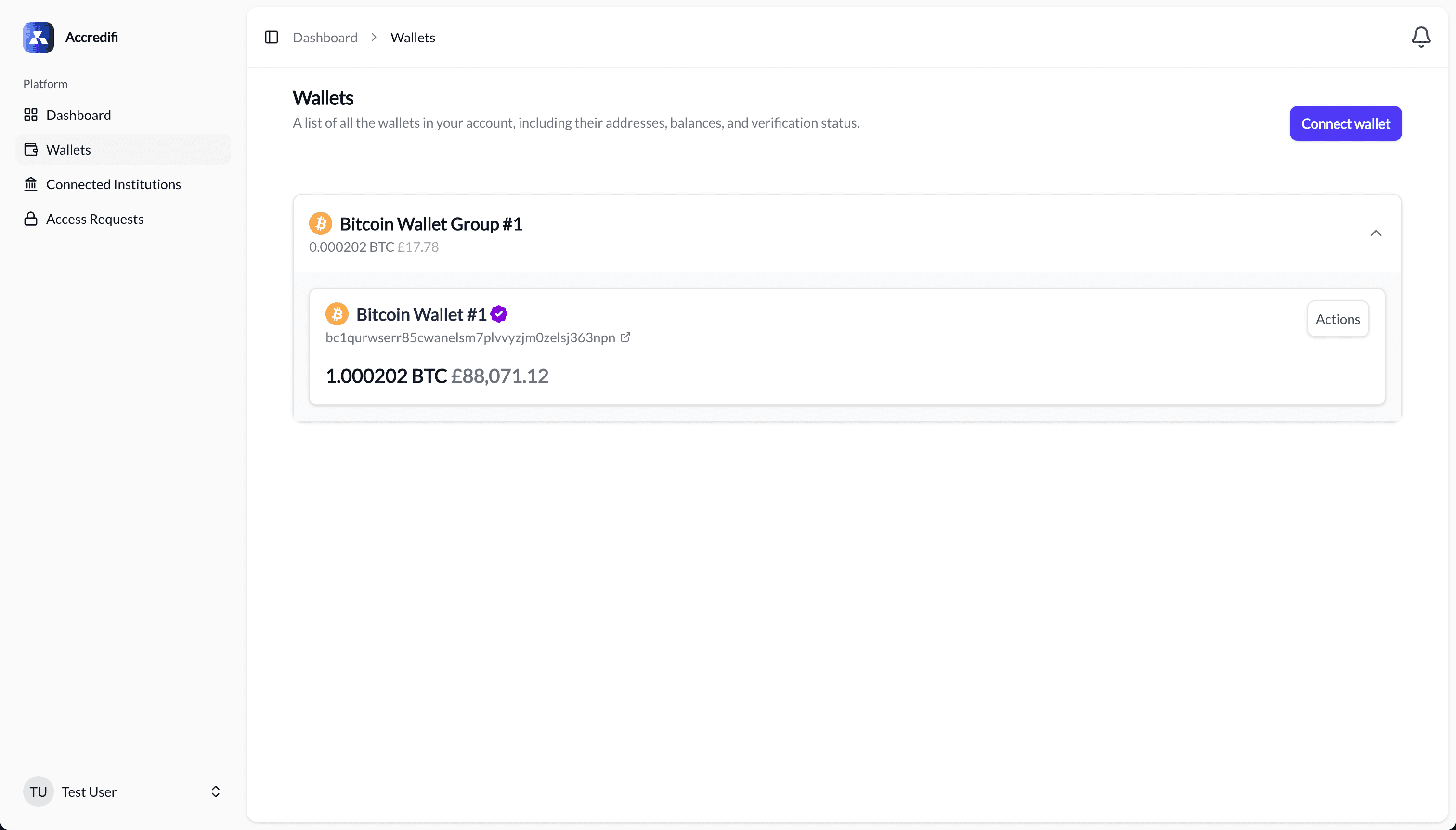
Product screenshot
Verification
Cryptographically Secure
The verification lifecycle

From request to ongoing state

Not a one-time check. An ongoing relationship with state your systems can enforce.

01

Request access

Institution creates an access request for the user. Email, one-time link, or API redirect.

02

User verifies

User connects wallet and signs a verification message. Proves control without revealing keys.

03

Access granted

Cryptographic proof is stored with timestamp. Institution can retrieve data via API.

04

State persists

Verification status tracks over time. Reverification schedules keep the relationship current.

Where teams use this

Lending, underwriting, compliance, and onboarding flows that need to verify self-custodied crypto.

Crypto-backed lending

Verify collateral before approving loans. API responses your underwriting system can consume.

Client onboarding

Replace screenshot-based proof of funds. Evidence that survives compliance review.

Ongoing compliance

Reverify holdings over time. Scheduled checks keep systems current.

Mortgage deposits

Accept crypto as proof of funds. Verifiable proof without asset transfers.

Legal and estate

Timestamped records for divorce, estate planning, or immigration.

Investment platforms

Verify accredited investor status and fund minimums at scale.

One layer. Both sides.

Users prove ownership. Institutions get verification. No custody compromise.

For Individuals

Prove wallet ownership when institutions need it. Your keys stay with you. You control who sees what, and for how long.

  • No custody transfer:Sign to prove ownership. Assets never move.
  • Access control:Set expiry. Revoke anytime. See who has access.
  • Evidence that works:Replace screenshots with cryptographic proof.
Learn more

For Institutions

Add wallet verification to existing flows. REST API, webhooks, hosted links. No custody required.

  • API-first:Create requests, receive webhooks, retrieve data.
  • Audit-ready:Cryptographic proof with timestamps. Defensible.
  • Stateful:Reverification schedules. Status tracking. Full trail.
Learn more
Trusted integrations

Verify with the world's most trusted wallets

Accredifi integrates with leading crypto wallets to ensure secure, non-custodial verification.

MetaMask crypto wallet extension
MetaMask
Trezor crypto hardware wallet
Trezor
BitBox crypto hardware wallet
BitBox

More wallets and blockchains coming soon

FAQ

Frequently asked questions

No. Never. We never request transfers, approvals, or access to your private keys. We only request a cryptographic signature to prove ownership, and we capture balance snapshots via view-only access. Your assets stay in your wallet at all times.

Screenshots can be faked. Our cryptographic signatures prove you control the private key without revealing it. Institutions can verify the proof on-chain, making it tamper-proof and trustworthy.

Only the institutions you explicitly grant access to. You set expiry dates, and you can revoke access at any time. We don't share your data with anyone else, and you can see exactly who has access in your dashboard.

The institution immediately loses access to your wallet data. They're notified via webhook, and any cached data becomes invalid. You maintain full control over who sees what, and when.

Institutions receive a cryptographically signed snapshot that they can verify on-chain. The signature proves you control the wallet, and the snapshot shows balances at a specific point in time. It's tamper-proof and auditable.

We support Bitcoin (BTC) and Ethereum (ETH) via MetaMask, Trezor, and BitBox. More chains and wallets are coming soon.

Yes. Our REST API lets institutions create access requests, receive webhooks for approvals and revocations, and retrieve wallet data programmatically. Full documentation is available for registered institutions.

Still have questions?

Contact our team
Latest insights

Crypto verification insights

Stay ahead with the latest on self-custody verification, compliance, and the future of decentralized finance.

View all posts
Quantum Won’t Break Bitcoin First. It Will Break Proof of Funds.
Mar 31, 2026

Quantum Won’t Break Bitcoin First. It Will Break Proof of Funds.

Quantum computing is often framed as an existential threat to Bitcoin. The earlier impact is likelier to be subtler: a loss of confidence in static cryptographic proofs, and with it, the reliability of crypto evidence in financial workflows.

Accredifi Team